
What is skin cancer?
Skin cancers arise when the cells in the different layers of the skin multiply without control. There are three common types, and they behave in markedly different ways:
- Basal cell carcinoma. This is the most common type. It grows slowly and the likelihood of spread to distant organs is very low; if it is left untreated, however, it advances where it sits, eating into the tissue.
- Squamous cell carcinoma. This grows more rapidly, and the risk of spread to the lymph nodes is higher than in basal cell carcinoma.
- Melanoma. This develops from the cells that produce pigment. It is comparatively less frequent, but its tendency to spread early makes it the type that calls for the greatest attention.
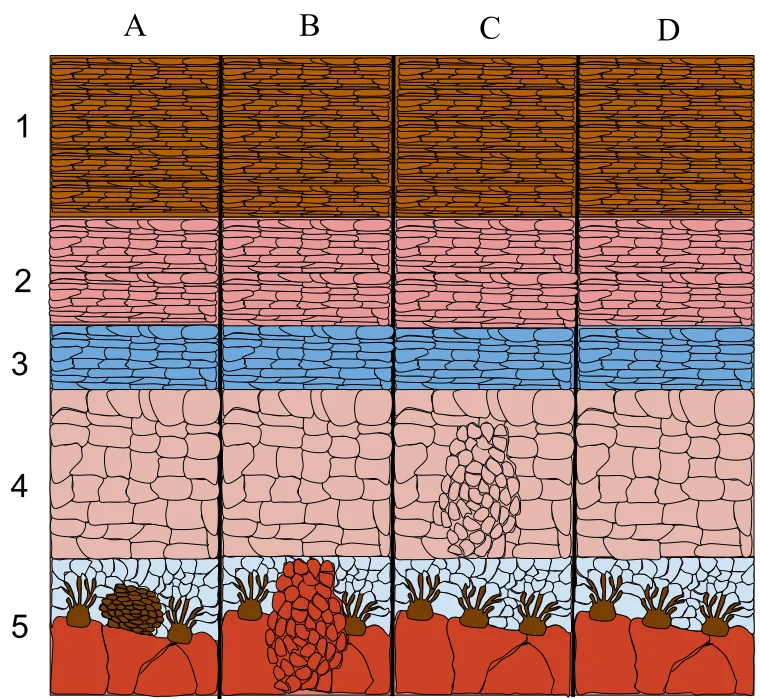
How is it noticed?
The most reliable warning sign is change. A lesion that is new, that is enlarging, or whose colour or border is altering should be assessed.
The features looked for in moles with regard to melanoma:
| What to look for | |
|---|---|
| A – Asymmetry | The two halves of the lesion do not resemble one another |
| B – Border | The edges are irregular, notched or indistinct |
| C – Colour | More than one shade is present within it; brown, black, red and white areas |
| D – Diameter | The diameter exceeds roughly 6 mm |
| E – Evolution | Change in size, colour, surface or sensation over time |
Beyond these, a wound that does not heal is the finding most often missed: a superficial wound that fails to close for weeks, that crusts over and opens again, and that bleeds from time to time must always be assessed, particularly over the face and the ear.
Diagnosis
The diagnosis begins with clinical examination and dermoscopic assessment; it is confirmed by biopsy. The pathology result determines not only the type, but also how wide the surgical margin needs to be and whether further investigation is required.
In melanoma the depth (thickness) of the lesion is the foundation of the treatment plan; taking the biopsy by the correct technique is therefore important.
Surgical treatment
The mainstay of treatment in skin cancer is removal of the tumour together with a margin of healthy tissue. The width of the margin is determined by the type, the size and the site of the tumour.
- Margin control. In regions such as the face, where economy of tissue matters, it is preferred to proceed with the margins checked during surgery or in the light of the pathology result. The aim is to remove the tumour completely without taking more healthy tissue than is needed.
- Lymph node assessment. In melanoma and in selected cases of squamous cell carcinoma, examination of the first draining lymph node may be required.
- Reconstruction. The defect that remains once the tumour has been removed is closed by direct suture, with a skin graft, or with a flap prepared from the neighbouring tissue. On the face, incisions and flap margins are planned with the natural lines and the aesthetic units in mind.
In some cases the reconstruction is carried out at a second session, once the pathology result is clear. This is a deliberate choice, made in order to be certain that the margin is clean.
Afterwards and follow-up
The pathology report after surgery shows whether the margins are clean and whether further treatment is required. Where necessary, additional treatment is planned together with oncology.
Because the likelihood of a further skin cancer is increased in someone who has already had one, regular skin examination is a permanent part of follow-up. Sun protection, protective clothing and the habit of keeping to the shade reduce the risk of new lesions.
Assessment
The most important factor determining the outcome in skin cancer is early diagnosis. Removing a small lesion is both a simpler procedure and one that leaves far less of a mark in terms of appearance.
If you have a lesion on your skin that is new, that is changing, or that is not healing, you are welcome to book an appointment for assessment.