What are cleft lip and cleft palate?
The face forms in the first weeks of pregnancy, as separate parts grow towards one another and join. When that joining is not completed, an opening remains in the lip, the gum ridge or the palate. Cleft lip and palate is the name for this failure of fusion, and it is the most common of the congenital facial anomalies.
The cleft is not the same in every baby:
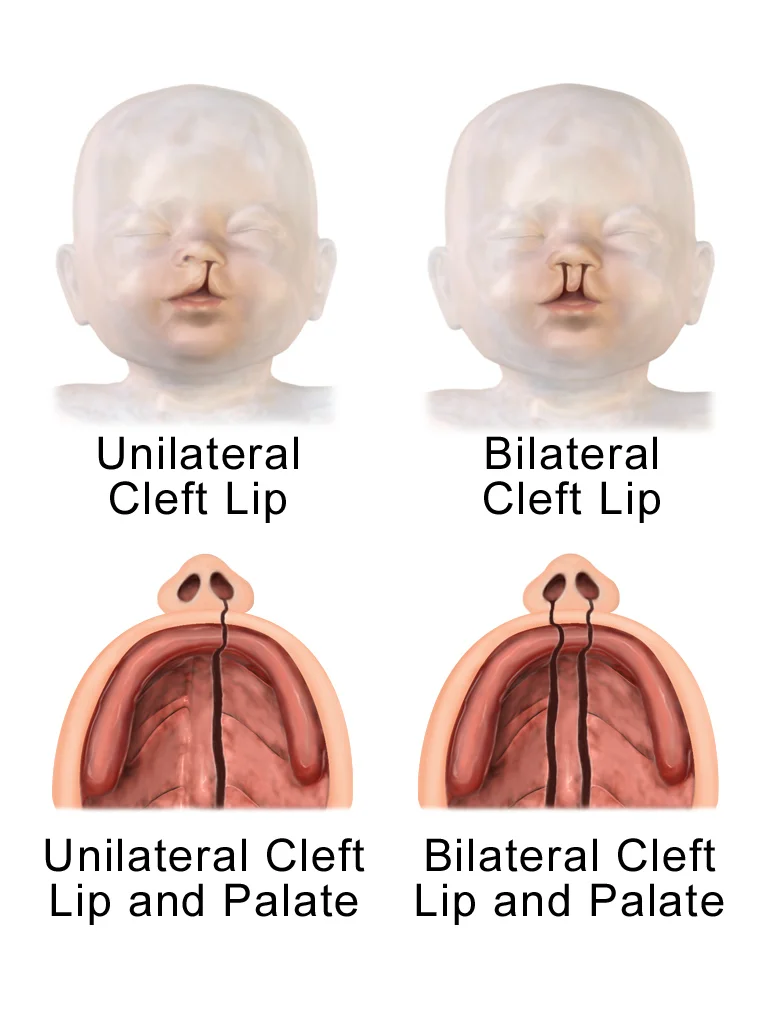
- It may involve the lip only, ranging from a small notch to a complete opening extending to the base of the nose.
- It may involve the palate only; in this case the lip looks normal and the diagnosis can be missed at first glance.
- Involvement of both the lip and the palate is the pattern seen most often.
- It may be unilateral or bilateral.
Why does it happen?
In most cases a cleft cannot be traced to a single cause. Genetic predisposition and environmental factors during pregnancy are thought to act together. A similar condition in the family increases the likelihood; in a substantial proportion of cases, however, no other family member is affected.
Known risk factors include smoking and alcohol use during pregnancy, certain medicines and folic acid deficiency. On the other hand, nothing the mother did or did not do during pregnancy is the cause of this condition. That is the sense of guilt families most often carry, and it is unwarranted.
Where the risk of recurrence is a concern, genetic counselling gives the most accurate answer.
Which functions are affected?
A cleft is not only a difference in appearance; it affects a series of functions together. This is why treatment is long-term and multidisciplinary.
- Feeding. An opening in the palate makes it harder to generate the pressure needed for sucking.
- Speech. The palate directs sound correctly between the mouth and the nose; until it is repaired, speech is affected.
- Hearing. Ventilation of the middle ear may be impaired, leading to recurrent middle ear fluid and hearing loss.
- Dental development. Teeth along the cleft may be missing, extra or malpositioned.
- Facial growth. Growth of the upper jaw may be affected, which calls for orthodontic and sometimes surgical correction in later years.
Diagnosis
Clefts of the lip are often noticed on ultrasound during pregnancy. Clefts involving the palate alone are harder to detect on prenatal imaging.
After birth the lip, the gum ridge and the palate are examined in detail, and the posterior edge of the soft palate is always assessed. In the first days the adequacy of feeding and weight gain are monitored, and newborn hearing screening is performed.
Treatment is a process
Treatment of cleft lip and palate is not a single operation but a staged programme that accompanies the child’s growth. The sequence below shows the general framework; timing is set for each child according to the type of cleft, weight gain and general health.
- First weeks — feeding and preparation. Choosing a suitable bottle and teat, teaching feeding technique, monitoring weight. Where required, an intraoral plate and nasal moulding prepare the tissues for surgery.
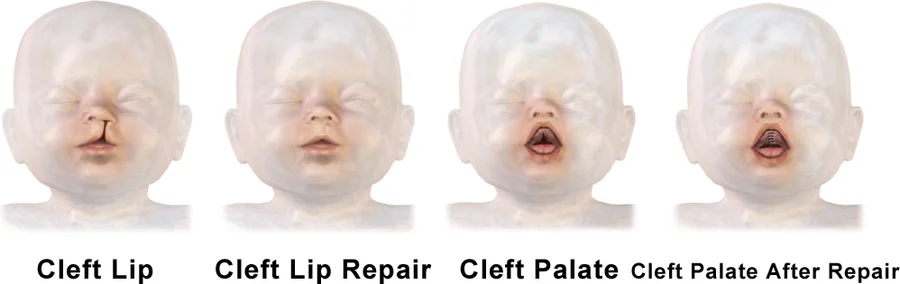
- Around 3–6 months — lip repair. The lip muscle, the skin and the base of the nose are repaired together. The aim is not merely to close the opening but to restore movement of the lip and symmetry of the nose.
- Around 9–18 months — palate repair. Planned before speech begins to develop. The palatal muscles are reconstructed so that sound is directed correctly.
- Ear follow-up. Middle ear ventilation is monitored and a grommet placed if needed. Hearing is decisive for speech development.
- Speech assessment. A speech and language therapist reviews the child regularly. If air still escapes through the nose despite palate repair, a further procedure may be planned.
- Around 8–11 years — alveolar bone grafting. The bony gap along the cleft is completed with a graft, timed to the eruption of the permanent teeth.
- Orthodontic treatment. Tooth alignment and the bite are corrected; once growth is complete, orthognathic surgery may be used to correct the position of the upper jaw.
- After adolescence — final refinements. Fine adjustments to the nose and lip are made once facial growth is complete.
Treatment is delivered by a team
Cleft lip and palate is the work of a team rather than a single doctor. The team includes a plastic surgeon, an ear, nose and throat specialist, a speech and language therapist, an orthodontist, a dentist, a paediatrician, a geneticist and, where needed, a psychologist.
What makes this approach matter is that the decisions depend on one another: the timing of palate repair affects speech, speech outcomes determine whether a further procedure is needed, and growth of the upper jaw shapes the orthodontic plan. A team that follows the same child over years can plan each step at the right time.
The family’s role
The family is one of the most decisive parts of the process. Applying the feeding technique correctly, keeping to review appointments and continuing speech therapy recommendations at home have a direct effect on the long-term result.
Although the treatment spans years, there are long intervals between the steps, and the child lives an age-appropriate life throughout.
Assessment
The type and width of the cleft and any associated findings differ in every baby, and the treatment programme is built accordingly. Early assessment matters, both to secure feeding and to plan each step at the right time.
If your baby has a cleft lip or palate, you are welcome to book an appointment so that we can plan the process together.