
What is orthognathic surgery?
Orthognathic surgery is the surgical treatment that corrects the position of the upper and lower jaw in relation to each other and to the base of the skull. The aim is not simply to align the teeth but to place the jaws correctly as skeletal structures.
That distinction is the heart of the treatment. If the problem lies in how the teeth sit against one another, the solution is orthodontic. But if the bones carrying the teeth are themselves set too far back, too far forward or asymmetrically, moving the teeth is not enough; the position of the jaw itself has to be changed.
Correction improves functions such as chewing and biting, and brings a balanced change to the facial profile as well. Orthognathic surgery is nevertheless not a cosmetic procedure: its primary goal is function, and the aesthetic improvement follows from it.
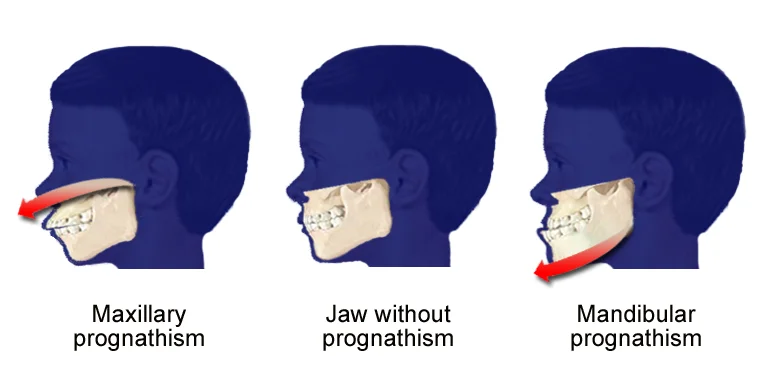
When is it considered?
- A lower jaw set too far back, with a weak chin and a flattened profile
- A lower jaw that projects forward, so the lower teeth close in front of the upper teeth
- An underdeveloped or overgrown upper jaw
- An open bite, in which the front teeth never meet
- Marked asymmetry between the right and left halves of the face
- Difficulty with chewing, biting, swallowing and speech
- Habitual mouth breathing and sleep apnoea
- Severe jaw deformities forming part of certain congenital and syndromic anomalies
The presence of these findings does not by itself mean surgery. In some cases orthodontic treatment alone is sufficient; the decision follows a measured assessment of the skeletal structure.
Diagnosis and planning
Assessment begins with a clinical examination: the bite, the relationship of the teeth, mouth opening, the jaw joint and facial symmetry.
The methods used in planning:
- Cephalometric radiography. Measurements taken from a lateral skull film define the position of the jaws relative to the skull base numerically.
- Three-dimensional imaging. Where required, CT is used to assess the three-dimensional geometry of the jaws and the jaw joint.
- Dental models and model surgery. The planned movement is first carried out in the laboratory on models prepared from intraoral impressions.
- Virtual surgical planning. The operation is performed in advance digitally; the extent of movement and the resulting bite are confirmed through this plan.
- Occlusal splints. Patient-specific appliances that guide the planned position during surgery.
In assessing the face, the heights of the upper, middle and lower thirds are considered together with the relationships of these segments along the front-to-back and right-to-left axes. The face is read as a whole; no decision rests on a single measurement. Because facial anatomy differs between populations and between individuals, the plan is specific to each patient.
Why is orthodontic preparation necessary?
Orthognathic surgery is a treatment carried out jointly by the orthodontist and the plastic surgeon.
Before surgery, the alignment and angulation of the teeth are corrected, so that the teeth can close correctly once the jaws reach their new position. After surgery, treatment continues for a period to fine-tune the bite.
It matters that this preparation is carried out by an experienced team. When a bite problem of skeletal origin is addressed by moving the teeth alone, the underlying cause remains, so the teeth drift back towards their former position over time; the roots are overloaded, the gums may recede, and the result falls short both functionally and in appearance. Establishing whether surgery is needed before treatment begins is far easier than correcting the course later.
Surgical techniques
Surgery is performed under general anaesthesia. Which jaw is operated on, and the direction and extent of the planned movement, are determined beforehand by measurement.
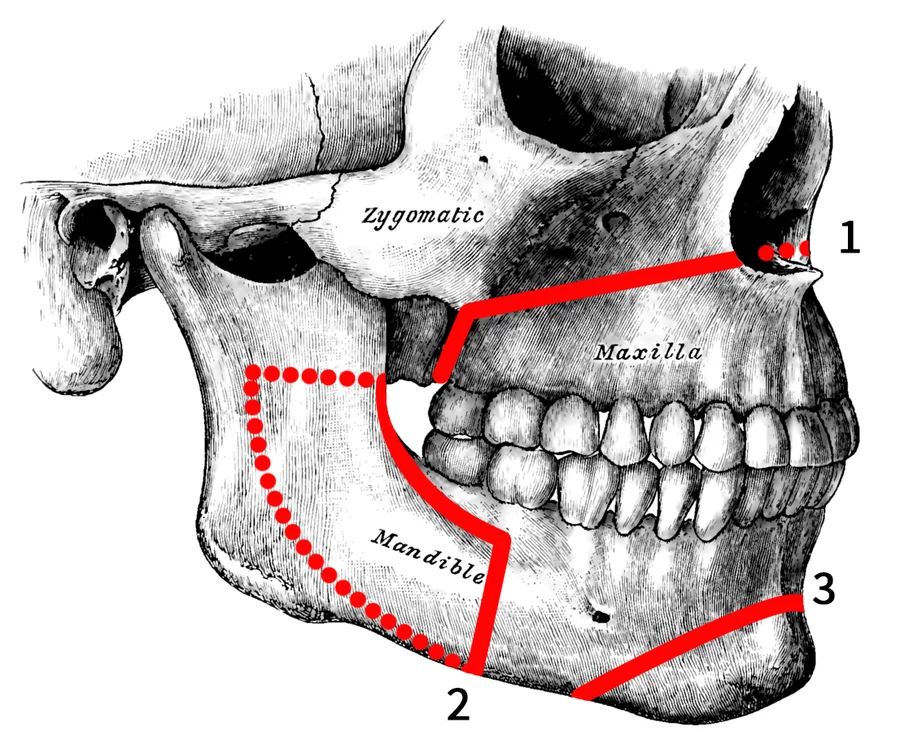
- Le Fort I osteotomy. The upper jaw is released above the level of the tooth roots and moved to the planned position.
- Bilateral sagittal split osteotomy. The lower jaw is divided in a controlled manner on both sides and set forward, backward or in the direction that corrects asymmetry.
- Genioplasty. The chin bone is repositioned separately to complete the balance of the profile.
Where required, these procedures are combined in the same operation. Because the incisions are made inside the mouth, no scars remain on the face. The jaws are fixed in their new positions with titanium plates and screws compatible with magnetic resonance imaging; the sutures inside the mouth dissolve on their own.
During upper jaw surgery, problems of the nasal base and the septum can be addressed in the same session. In lower jaw surgery the sensory nerve running through the region is carefully protected; temporary numbness of the lower lip and chin may follow, but a permanent change is not the expected outcome.
Timing
As a rule, orthognathic surgery is planned after growth is complete, which usually falls after the age of 17–18. A correction made while growth continues may be undone as the jaws develop further.
Earlier intervention may be required in cases with syndromic anomalies, severe breathing problems or marked loss of function. Such decisions call for experience and a multidisciplinary assessment.
Recovery
- The hospital stay is usually 2–3 days.
- Facial swelling is most pronounced in the first days and then subsides gradually.
- A liquid and soft diet is followed early on; oral hygiene is particularly important in this period.
- Elastics are used for a period so that the bite heals in the intended position.
- Bone healing is largely complete after 3–4 months, and the swelling resolves fully over the same span.
These intervals vary with the patient’s age, the procedure performed and the pace of healing. Follow-up continues jointly until orthodontic treatment is completed.
Assessment
The decision to proceed with orthognathic surgery comes from reading measurements, imaging and the orthodontic assessment together. Two bites that look alike may call for different treatment.
If you have a question about your bite or your facial profile, you are welcome to book an appointment for assessment.